
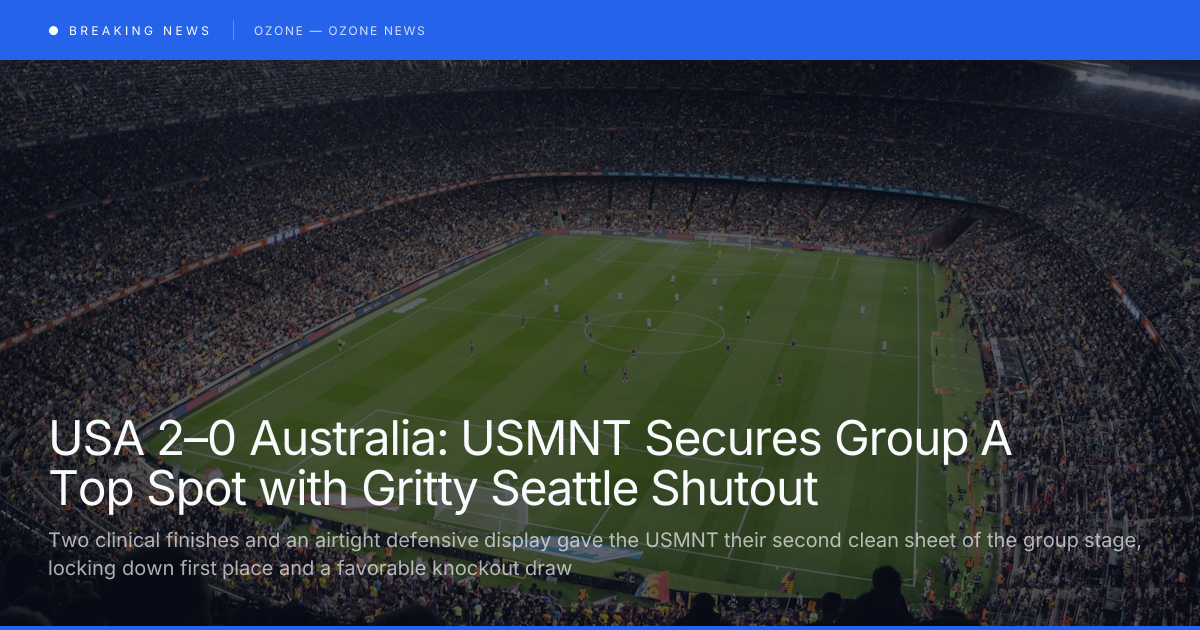
Lumen Field in Seattle was loud before kick-off and louder still by the final whistle. The USMNT delivered the result their home crowd demanded — a 2–0 win over Australia that sealed first place in Group A and, more importantly, handed the United States the kind of favorable knockout draw that can be the difference between a tournament run and an early exit.
This was not the expansive, attacking football that USA 4–1 Paraguay suggested might be the team's defining mode. Against Australia's organised and physically competitive side, the USMNT produced something more controlled, more defensive, and — over 90 minutes — more impressive for precisely those reasons. They were asked to be disciplined, and they were.
A Defensive Performance Built to Last
The United States came into this fixture knowing that a point was sufficient to guarantee qualification, and that a win would guarantee group victory. They approached the match accordingly — a compact shape, organized defensive rotations, and a clear understanding of how and when to press rather than a blanket aggressive press that could leave space for Australia's runners to exploit.
The back four operated with a consistent high line that compressed Australia's forwards into tight spaces. When Australia did manage to play through the first press, a second defensive line was in place to recover the ball before any genuine danger materialized. Over the course of the match the clean sheet reflected not just individual defensive quality — though there was plenty of that — but a collective system executing well under sustained second-half pressure.
Eighteen tackles won to Australia's 14 is a telling statistic in a match where the physical contest was close. The USA won those individual duels at a rate that prevented Australia from establishing the rhythmic possession they needed to build genuine attacking momentum. The midfield battle was the engine of the performance, and the USA won it.
Two Goals That Told the Story
Both USA goals came from the same tactical source: transitions. Australia's attacking approach demanded their full-backs push forward, their midfield press high, and their defensive line compress. Those are reasonable tactics against a team willing to play through pressure. They become liabilities the moment possession is lost and a fast, organized counter is launched behind them.
The first goal arrived on exactly that template. Australia committed bodies forward in search of an equalizer they did not yet need — they were level at the time, which made the decision questionable — and the USA recovered possession in their own half, played through the press rapidly, and arrived at the Australian penalty area with numerical advantage. The finish was clinical.
The second goal, arriving in the closing stages, came from a similar pattern. By that point Australia needed to score and were committing even more aggressively forward. The spaces behind grew, the USA exploited them, and the counter was converted with the composure of a side that had practiced this scenario until it became automatic.
Australia | Competitive But Beaten
Australia deserve credit for the pressure they applied in the second half. Their 4 shots on target reflect a team that was genuinely threatening at moments rather than simply hoping for a deflection or defensive error. The Socceroos were well-organized, physically matched the USA for most of the contest, and showed the quality that had allowed them to defeat Türkiye 2–0 earlier in the group.
Their issue was the same one that afflicts any team built around high energy and forward commitment: when possession is lost in high areas, recovery is difficult. Against a USA side with the pace and technical quality to exploit those recovery moments, it proved costly twice. Against a lesser counter-attacking side, Australia might have turned their pressure into points.
Group A | USA Top, Knockout Picture Clear
The United States finish Group A in first place. The structural implication of that result extends beyond the symbolic. In the expanded 48-team format, group winners receive seedings that route them away from the strongest performers in parallel groups until at least the Round of 16. For a USMNT with genuine knockout ambitions, avoiding an early rematch with the tournament's heaviest favorites is a meaningful competitive advantage.
The Seattle crowd sensed the significance and responded accordingly. For a host nation that came into the tournament carrying the expectations of an entire country's developing football culture, this group-stage performance — disciplined, professional, results-driven — was the platform the team needed. The harder tests will come in the knockout rounds. The USA have given themselves the best possible starting position.