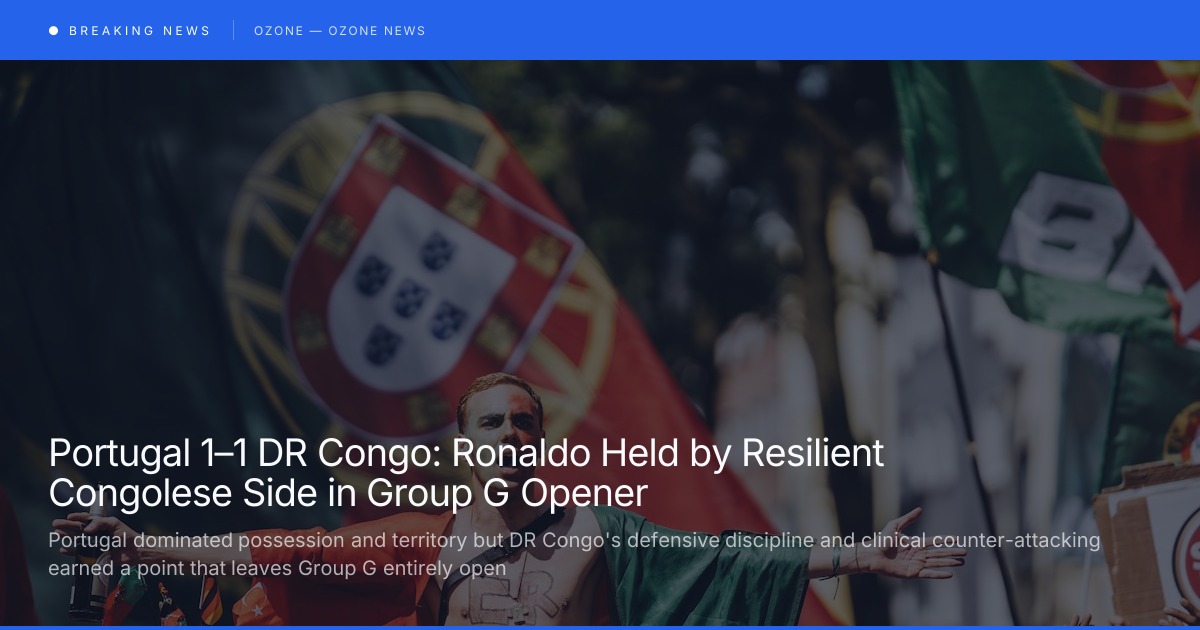
Portugal arrived in their World Cup 2026 Group G opener as clear favorites against a DR Congo side making only their second World Cup appearance. By the final whistle, they left with one point instead of three, outplayed tactically by a Congolese side that understood exactly how to frustrate one of the tournament's pre-eminent attacking teams.
The 1–1 scoreline is, statistically, a mild injustice to Portugal's territorial dominance. But football is not adjudicated by territory alone, and DR Congo's counter-attacking threat was genuine, their equalizer deserved, and their collective discipline over 90 minutes something that Portugal's coaching staff will spend the next 48 hours analyzing.
How DR Congo Frustrated Portugal
DR Congo's game plan was legible from the opening ten minutes and they executed it with a consistency that Portugal could not fully disrupt. Two compact defensive lines, narrow central corridors, a willingness to absorb pressure in their own half and then transition rapidly the moment possession changed hands.
Portugal's attacking patterns — width through the full-backs, central overloads through the number eight and number ten positions, Ronaldo as the reference point — were familiar and, against the DR Congo structure, containable. Every time Portugal circulated wide and tried to cross, a Congolese body arrived to block or clear. Every central combination that Portugal attempted was tracked by the compact middle block.
Where DR Congo created danger was in the spaces Portugal's high press left behind. The Congolese forwards had the pace to get behind the Portuguese defensive line on transitions, and on three or four occasions in the first half they found those spaces, with only the final ball or finishing touch letting them down.
Ronaldo and the Chances That Didn't Go In
Cristiano Ronaldo, at 41, is no longer the player who wins games through explosive individual brilliance alone. He is a different kind of threat now — positional intelligence, the penalty-box read, the ability to get himself into situations where a finish is required rather than a dribble.
He was involved constantly. He tested the DR Congo keeper from range in the 18th minute with a drive that required a sharp save. He headed wide from a corner in the 34th. He struck the post in the 67th minute from a position that, on another night, goes in. He was denied a second goal by a combination of excellent Congolese goalkeeping and Portugal's own profligacy in the delivery phase.
Portugal's 7 shots on target to DR Congo's 4 reflects a game where Portugal were the better side in aggregate terms. An expected-goals figure of 1.9 to 1.1 suggests they should have won. They did not win. The gap between those numbers and the scoreline is the story of the match.
Group G | Everything Is Open
Belgium, the other major Group G contender, drew 1–1 with Egypt on the same day. The group picture after Matchday 1 shows every team on one point, or — in the case of the teams who lost — searching for their first. The conventional wisdom heading into the tournament was that Group G would be resolved by a Portugal-Belgium showdown with the winner claiming top spot. That narrative has been complicated immediately.
Portugal now carry pressure into their remaining fixtures that was not anticipated after what was supposed to be a manageable opener. DR Congo, meanwhile, carry confidence. A team that has held one of Europe's strongest nations to a draw in their opening World Cup match of the modern era has earned the right to believe they can get results against the remaining group opponents.
The Portuguese coaching staff will be blunt in their internal review. The tactical adjustments necessary to break down disciplined low blocks — more varied crossing angles, earlier switches of play, more direct runs in behind from midfield runners — must be refined before the next fixture. One point from the opener is survivable. Two points from six would be a crisis.