
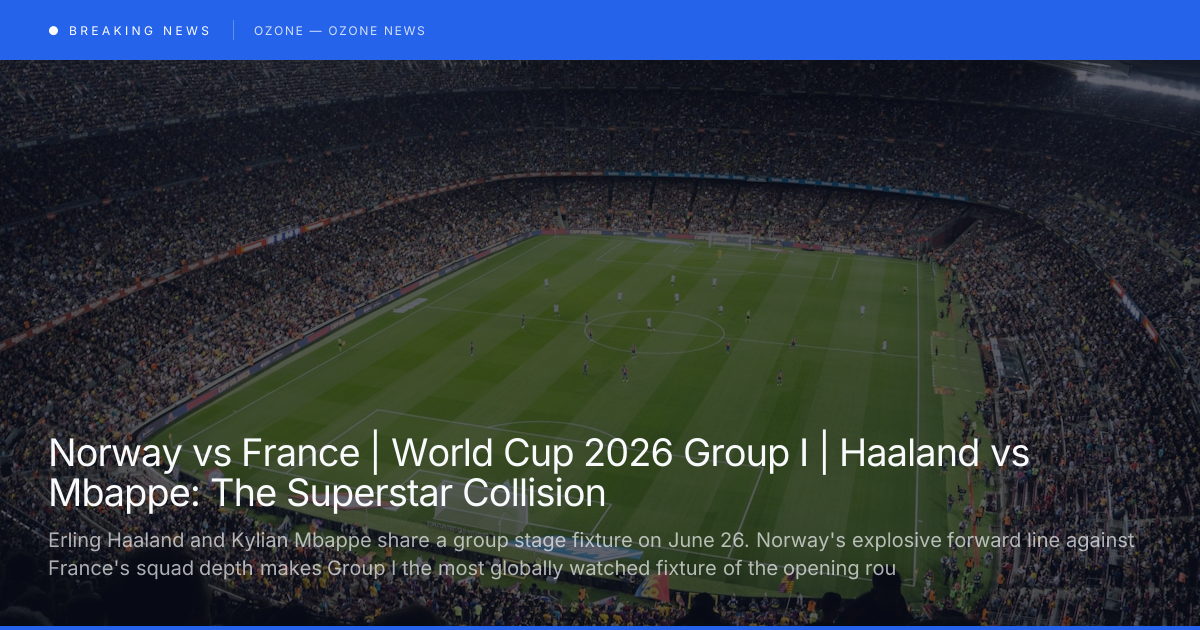
There are individual player matchups in major tournaments that transcend the game itself. This is one of them. Erling Haaland and Kylian Mbappe are the two best attacking players in the world. They share a group. They share a matchday. June 26 in Group I is the fixture that the 2026 World Cup has been building toward since the draw was made.
The framing as a personal duel is, of course, a simplification. Football is a collective sport and neither player wins or loses purely on individual contribution. But the simplification contains genuine substance. Haaland and Mbappe are the gravitational centers of their respective national teams. Every tactical structure, every set-piece design, every in-game adjustment flows from the need to maximize their threat or suppress the opponent's equivalent. When they share a pitch, the strategic weight placed on managing each player is real, measurable, and decisive.
Erling Haaland | Norway's Debut World Cup Striker
Norway have not played a World Cup since 1998. An entire generation of Norwegian football supporters grew up watching their country qualify reliably for European Championships and then fall short on the global stage. Haaland's emergence changed the calculus. Norway were not going to miss a World Cup with the tournament's most lethal striker in their squad, and they did not.
Haaland enters the France fixture as the tournament's leading scorer. His movement off the ball, his positioning in behind a defensive line, and his finishing efficiency inside the area are all at the maximum level of what the game can produce. Against a France side that defends from a high line, the question is not whether Haaland will get chances. It is whether France can keep the space behind their defenders tight enough to prevent the specific runs that define his game.
Norway's system is built for him. They press aggressively to win the ball in advanced areas, they recycle possession quickly through the wide positions, and they finish — nearly every attacking sequence — with a ball into the box where Haaland is positioned. It is not subtle, but it does not need to be. Haaland at the end of those sequences does not require subtlety.
Kylian Mbappe | France's Established Figurehead
Mbappe scored four goals in the 2022 World Cup final alone — including a hat trick that nearly produced the greatest comeback in tournament history. He walked out of that final, which France lost on penalties, carrying the weight of a performance that was simultaneously the best individual final display in World Cup history and the wrong end of a team result.
In 2026, he is no longer the young forward carrying the tournament on instinct and pace. He is the established leader of the most talented French generation since the 1998 and 2006 sides. France's squad depth in 2026 is legitimate: options in every position, genuine quality in central midfield, and a defensive organization that is more reliable than the 2022 vintage that kept conceding late in knockout games.
Against Norway, Mbappe's role is simpler than France's team structure might suggest. Norway will commit numbers forward and Norway will press high. That creates space in behind on the counter. Mbappe is the fastest attacking player in the world over the first thirty meters. If France can absorb Norway's press and play through it, the counter-attack spaces that open up are precisely where Mbappe is most dangerous.
The Collective Battle Behind the Superstar Duel
Norway's game plan against France is coherent and genuinely threatening. They will press early, commit their wide forwards to aggressive high-press lines, and attempt to force France's center-backs into uncomfortable build-out situations. If Norway can win the ball in France's half in the first twenty minutes and produce early pressure, they can disrupt France's organizational rhythm before it establishes.
France's counter to this is their midfield quality. Their central options include players capable of playing through a high press under pressure — finding the tight pass that relieves the press and immediately transitions from defense to attack. If France can execute that transition sequence twice in the first half, Norway's pressing structure begins to look less like a tactical weapon and more like a liability that creates space for Mbappe to run into.
Both sides advance from Group I regardless of this result. What they carry into the knockout round — bracket position, fitness, confidence, tactical momentum — is shaped here. A Norway win sends Haaland into the Round of 32 with the narrative of having beaten the tournament favorites. A France win sends Mbappe into the knockout phase with the platform of a commanding group performance.
June 26. The most watched group-stage fixture of the 2026 World Cup. It was always going to happen. Now it does.