
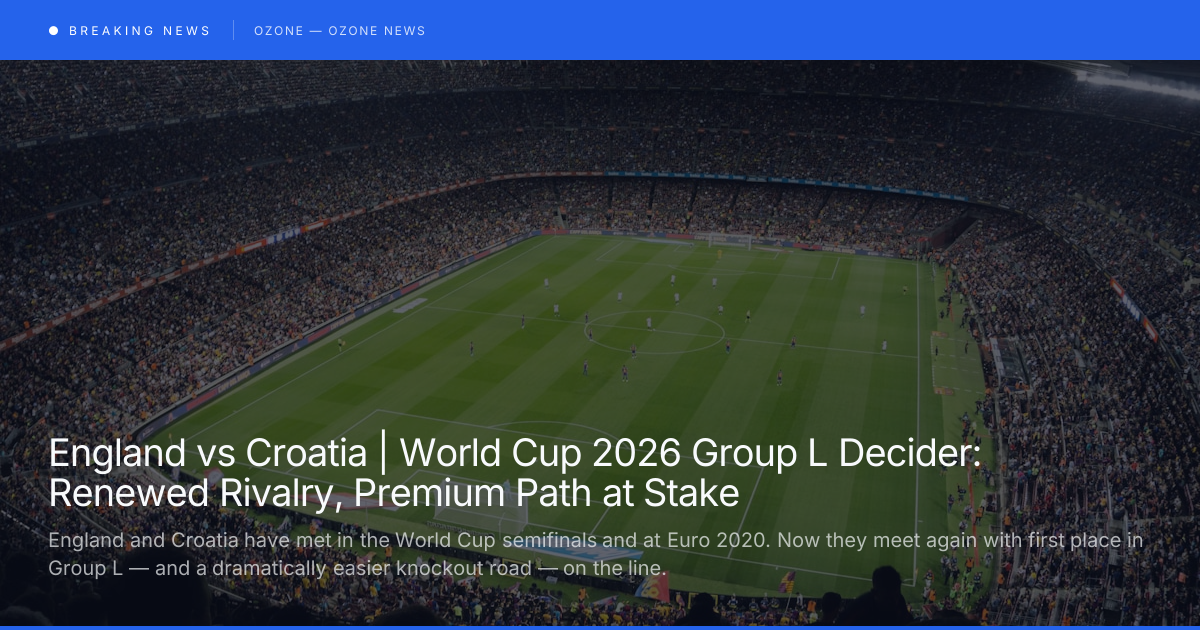
Three meetings. Two tournaments. Each one shaped the trajectory of a major competition. England and Croatia are meeting again at World Cup 2026 in a Group L decider that carries the same weight as every prior encounter — group leadership, bracket position, and the psychological edge of having beaten your fiercest tournament rival three times in the same era.
This is not a manufactured rivalry built on geographic proximity or media narrative. It is earned through evidence: Croatia's 2018 semifinal comeback, England's Euro 2020 response, and now this. The pattern of meetings has produced three genuinely competitive matches in which margin and momentum decided outcomes in tight games. The 2026 Group L decider has every reason to follow the same template.
England's Position | One Result from the Premium Path
England's group stage performance has been functional rather than exceptional. They have secured the points they needed without particularly convincing anyone that they are ready to threaten seriously in the knockout rounds. That is not necessarily a problem — the group stage exists to qualify, not to stage exhibitions — but it means the Croatia fixture arrives with England needing to demonstrate something more durable than efficiency against lower-ranked opposition.
The instruction from management heading into this game will center on controlling Croatia's midfield. England have the athleticism and the pressing engine to make life uncomfortable for aging playmakers operating in central areas. If England can deny Croatia rhythm in the 20-to-40-yard zone where their football is built, they remove the primary mechanism by which Croatia create chances.
Pace behind Croatia's defensive line is England's sharpest weapon. The full-backs push forward aggressively and can be caught by quick transitions when possession turns over. England have the personnel to exploit exactly that vulnerability, and the counter-press mechanics that define their best performances make winning the ball and running into space a natural sequence rather than a set-piece plan.
Croatia's Position | Final Proof of Concept
Croatia have been navigating this World Cup — as they have navigated every major tournament since 2018 — with a squad profile that invites the question: is this finally the cycle where the conveyor belt runs out? The midfield core that drove their 2018 semifinal run and their 2022 third-place finish is older, and the depth behind the established starting positions remains a point of uncertainty.
Against England, those questions become concrete rather than theoretical. England's press is specifically designed to compress the time available to technically gifted central midfielders who need space to operate. Croatia's playmakers work best with two or three seconds to assess and distribute. England's defensive shape, when it functions properly, allows closer to one.
But Croatia's experience — their genuine deep-tournament expertise across multiple World Cups — is not nothing. They have been in these pressure environments before. They know what a group decider feels like. They understand that knockout-tournament football is not won by the team that plays the most attractive football; it is won by the team that executes in the decisive moment. Croatia's record in decisive moments across the past decade is stronger than any context-free analysis of their squad profile would suggest.
The Tactical Contest | Midfield Control vs Pace in Transition
England want to press high, win the ball in Croatia's half, and run at a defensive line that struggles with pace in behind. Croatia want to absorb, find space in the half-spaces between England's midfield and defensive lines, and use their set-piece quality to threaten from dead-ball situations.
These are genuinely opposing game plans, which means the match will be defined by which side imposes their preferred structure more effectively. The first fifteen minutes will establish momentum. If Croatia can establish midfield rhythm in the opening spell, England will be forced to adapt. If England's press disrupts Croatia immediately, the rest of the match will play out on England's terms.
A reminder of the historical ledger before kick-off: Croatia won in 2018 when the pressure was highest. England won in 2021 when the pressure was somewhat lower. The 2026 iteration, with more at stake than either previous encounter, will reveal which direction this series is actually running.