
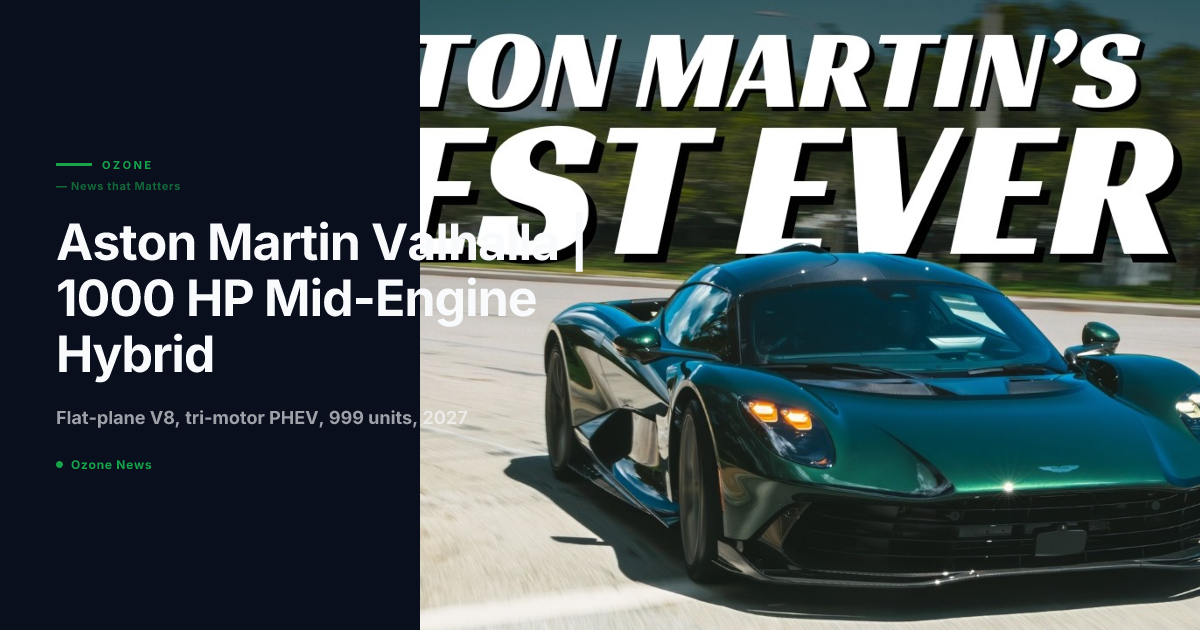
For decades, Gaydon was defined by the classic front-mid engine grand tourer layout, long, sweeping hoods housing roaring V8s and V12s wrapped in elegant British tailoring. However, as the brand's high-performance ambition evolved alongside its active presence on the Formula 1 grid, Aston Martin set its sights on a completely new architectural horizon: the exotic, mid-engine hypercar realm.
Entering full production maturity for the 2027 model year, the Aston Martin Valhalla serves as the brand's first series-production mid-engine hybrid hypercar. Designed with direct technical input from Aston Martin Performance Technologies (AMPT) and the Aston Martin Aramco Formula One Team, the Valhalla bridges the gap between the track-only Valkyrie extreme concept and daily road-legal usable performance.
The Hybrid Powertrain | AMG V8 Meets Tri-Motor Electrification
At the physical center of the Valhalla sits a bespoke, flat-plane crank 4.0-liter twin-turbocharged V8 engine, developed in close technical partnership with Mercedes-AMG. The high-revving internal combustion engine, which revs out to 7,200 RPM, drives the rear wheels exclusively. Working alongside the V8 are three compact electric motors: two on the front axle to provide dynamic torque-vectoring all-wheel drive, and a third integrated directly into the custom eight-speed dual-clutch transmission.
By eliminating the heavy physical reverse gear inside the eight-speed transmission and allowing the front electric motors to handle rearward maneuvering, Aston Martin engineers saved significant mechanical weight while optimizing gearbox packaging.
- Internal combustion: 4.0L twin-turbo flat-plane crank V8 (about 800 HP).
- Electrification: 3 electric motors, 2 front axle and 1 integrated in the 8-speed DCT.
- Total combined output: about 1,000 horsepower (1,012 PS / 745 kW).
- Transmission: 8-speed e-DCT with no physical reverse gear.
Carbon Architecture and F1 Aerodynamics
The foundation of the Valhalla is an ultra-lightweight, high-rigidity carbon fiber tub engineered to maximize structural integrity while keeping total dry vehicle weight under 1,550 kilograms (3,417 lbs).
The active aerodynamic surfaces are tuned to respond continuously to vehicle speed and driver inputs. In full track mode, the active front wing and massive multi-element rear wing morph dynamically to generate over 600 kilograms (1,322 lbs) of downforce at 149 mph (240 km/h), pinning the hypercar to the tarmac without requiring drag-inducing fixed wings.
Performance Targets
Key 2027 Valhalla performance targets include a 0-60 mph sprint in under 2.5 seconds, a 217 mph top speed, and about nine miles of EV-only range. Production is strictly capped at 999 units worldwide.
Cockpit Ergonomics | The Pilot Philosophy
Inside the cabin, the Valhalla favors a stark, functional layout derived from modern racing cockpits. The driver and passenger sit in fixed carbon-fiber bucket seats, with the pedal box and steering column adjusting relative to the occupant, a packaging layout taken directly from modern single-seater race cars. A minimalist dual-screen digital interface handles telemetry, drive-mode selection, and Apple CarPlay connectivity.
The Strategic Shift for Gaydon
The arrival of the Valhalla marks a pivotal moment in Aston Martin's modern manufacturing history. By establishing a dedicated, highly mature mid-engine platform, the marque transforms from a traditional boutique GT manufacturer into a direct, credible challenger to mid-engine stalwarts like Ferrari, McLaren, and Lamborghini. The Valhalla stands as physical proof that British craftsmanship and world-class motorsport engineering can coexist inside a single, 1,000-horsepower package.
Sources
- Aston Martin Official Media Room | Valhalla Technical Specifications
- Car and Driver | Aston Martin Valhalla: Everything We Know About the 1000-HP Hybrid
- Top Gear | Aston Martin Details the Production-Ready Valhalla
- Motor Trend | Aston Martin Valhalla Hypercar Hybrid System Breakdown
For more automotive coverage, visit the Cars hub, or read our reports on the Koenigsegg CCGT1 track homage and the Hennessey Venom F5-M manual hypercar.